Humanitarianism(s) in Transition: Between Ideals, Power and Agency
When: 21 – 22 April 2026
Where: silent green Kulturquartier, Gerichtstraße 35, 13347 Berlin
The Humanitarian Congress Berlin 2026 brings together diverse voices to reflect on a humanitarian sector in profound transition. Under the theme “Humanitarianism(s) in Transition: Between Ideals, Power and Agency,” the Congress explores how humanitarian principles are challenged by political pressure, declining norms, and shifting global power dynamics. The program critically examines the gap between reform ambitions and realities on the ground. Itaddresses growing risks for civil society and local actors, and discusses how legitimacy, trust, and accountability can be rebuilt in an era of shrinking civic space and rising anti-aid narratives. At the same time, the Congress looks ahead, highlighting debates on the future of global health, access to lifesaving care in crises, and more integrated, sustainable approaches that link health, climate, and justice. Sessions on localization and service transitions explore how humanitarian action can move toward locally led models, while discussions on storytelling and voice question who defines crises and whose perspectives shape global responses. Together, the Congress offers a compact yet critical space to rethink humanitarian action in a rapidly changing world.
Have a first look at the exciting programme now and secure your ticket!
Please note that the programme is still under development and may be subject to changes.
09:15 – 10:30 | Betonhalle & Kuppelhalle (livestream available)
Welcome & Keynote Dialogue with Nadine Saba & Hansjoerg Strohmeyer
Welcome & Keynote Dialogue with Nadine Saba & Hansjoerg Strohmeyer
Welcome Note:
Tammam Aloudat | CEO, The New Humanitarian
Keynote Speaker:
Nadine Saba | Co-Founder and Director, Akkar Network for Development
&
Hansjoerg Strohmeyer | Chief of the Policy Development and Studies Branch, OCHA
Chair:
Krizna Gomez | Social Change Maker, Rogue Union
11:00 – 12:30 | Betonhalle (livestream available)
Holding Humanitarianism(s) to account: accountability through fact-based, independent reporting and other mechanisms
Holding Humanitarianism(s) to account: accountability through fact-based, independent reporting and other mechanisms
Crises often expose the limits of humanitarian action: from gaps in protection to failures of access and responsibility. This session will explore how demands for accountability are pursued, challenged, or deflected within the humanitarian system, and what role journalism, local perspectives, and affected communities play in ensuring the sector answers to those it is meant to serve.
Nour Khalil | Co-Founder and Executive Director, Refugees Platform in Egypt
Anja Osterhaus | Human rights, press freedom, development and humanitarian aid specialist
Shahd Hammouri | Lecturer in Law, University of Kent
Chair: Tammam Aloudat | CEO, The New Humanitarian
11:00 – 12:30 | Kuppelhalle (livestream available)
From Milestones to Momentum: The Evolution of Humanitarian Action
From Milestones to Momentum: The Evolution of Humanitarian Action
Over the past decades, the humanitarian system has introduced major reforms and celebrated important achievements – from stronger coordination and accountability to higher professional standards. Yet questions remain: how much of this change has truly taken root, and how much exists only on paper? This panel will critically explore the gap between ambition and reality, examining where progress is visible, where it falls short, and which practices may need to be left behind. It will also address the pitfalls of implementation and why advances so often falter when principles collide with politics and practice. Rather than accepting half-measures, the discussion aims to chart a way forward: how can humanitarian action become stronger, more credible, and better equipped to uphold its principles in the face of today’s challenges?
Adelina Dwi Ekawati Kamal | Co-Founder and Steering Committee Member, Southeast Asian Women Peace Mediators (SEAWPM)
Dr. Michael Court | CEOc, Global Support and Development
Arbie Baguios | Director, Aid Re-imagined
Christof Johnen | Director International Cooperation, German Red Cross
Chair: Dr. Sema Genel Karaosmanoglu | Director, Hayata Destek / Support to Life (STL)
13:30 – 15:00 | Betonhalle (livestream available)
The power of networks: Co-Creating a Locally Led Humanitarian Future
The power of networks: Co-Creating a Locally Led Humanitarian Future
Reform in the international humanitarian system remains mostly driven by global actors, with limited local input. Since the 2016 World Humanitarian Summit, local and national networks have grown stronger and more professional, despite facing structural barriers and limited resources. These networks bring together civil society organizations to influence policy, engage international actors, and promote locally led humanitarian, development, and peace efforts. As the aid system is pushed to become more efficient, accountable, and locally driven, these networks offer vital, context-specific perspectives. They don’t just call for power shifts—they actively co-create new aid models. By defining shared priorities and testing equitable partnerships, they help reshape localization and drive real systemic change. So how can we create more space for these networks and support their transition to locally led approaches in today’s changing context?
Mahmoud Hamada | Advocacy Coordinator, Palestinian NGOs Network
Laura Victoria Alzate Rodríguez | Member of the Assembly and of the Strategic Team, Fundación Halü Bienestar Humano
Chair: Lene Grønkjær | Advocacy Advisor, Local Humanitarian Leadership & Humanitarian System Reform
13:30 – 15:00 | Kuppelhalle (livestream available)
Not optional: Sexual and reproductive health care in emergencies
Not optional: Sexual and reproductive health care in emergencies
While on the normative level, advances have been made to acknowledge sexual and reproductive health services as life-saving care, implementation has been slow, threatened by global funding cuts and the right to sexual and reproductive health deliberately under attack by the anti-gender movement. This session will identify challenges and explore solutions to overcome barriers in accessing SRH in emergency settings, including safe abortion care (SAC) and contraception. We will convene a diverse round of experts with humanitarian, political and activist backgrounds, to provide concrete recommendations to donors, service providers and political leaders to ensure access to the full range of SRH services.
Maura Daly | Lead Technical Platform on SRH, Doctors without Borders
Annick Villarosa | Head of Unit Humanitarian Aid Thematic Policies and International Humanitarian Law, European Commission
Nelly Munyasia | Executive Director, Reproductive Health Network Kenya
Dr. Mike Mpoyi | Associate Director, Quality of Care, IPAS
15:30 – 18:00 | Atelier
Gender in Emergencies: Wishful thinking or non-negotiable?
Gender in Emergencies: Wishful thinking or non-negotiable?
As the humanitarian system faces fragmentation, shrinking access, and erosion of legal and ethical standards, gender-responsive and feminist approaches are increasingly under pressure. This workshop explores how feminist principles and gender-sensitive responses can be upheld and operationalized in emergency contexts. It highlights the risks of neglecting gender, shares practical experiences, and discusses how inclusive approaches strengthen the legitimacy, effectiveness, and humanity of humanitarian aid.
15:30 – 18:00 | Kuppelhalle
Breaking the Frame: the Future of Humanitarian Narratives
Breaking the Frame: the Future of Humanitarian Narratives
The humanitarian sector faces what some call a legitimacy crisis as donor publics grow
skeptical of aid. Yet this framing misses a deeper reality: affected communities have long
questioned a system built on narratives that marginalize their agency, experiences and understanding of aid. Addressing the humanitarian sector’s struggle to reform and adapt to changing global dynamics, this participatory session examines how narratives sustain structural barriers to meaningful change. It invites participants to engage with competing narrative frameworks and visions shaping humanitarian action today—from traditional Western institutions to emerging and local actors. Ultimately, participants are encouraged to reflect on which voices and visions should guide reform and how Global North-based actors could support – rather than direct – change.
Regina “Nanette” Salvador-Antequisa | Executive Director, Ecosystems Work for Essential Benefits, Inc. (EcoWEB)
Patrick Gathara | Senior Editor; Inclusive Storytelling, The New Humanitarian
Sonja Hövelmann | Research Lead, Centre for Humanitarian Action
Martin Searle | Director of Analysis, Doctors without Borders Hong Kong
15:30 – 18:00 | Betonhalle
Beyond Silos: Applying One Health in Fragile and Climate-Affected Settings
Beyond Silos: Applying One Health in Fragile and Climate-Affected Settings
Climate change, conflict, and collapsing ecosystems are increasingly intertwined, driving humanitarian needs and systemic injustice. This interactive session explores how the One Health approach—linking human, animal, and environmental health—can offer practical, locally adapted solutions in complex crisis settings. Using real-world scenarios from arid, conflict-prone regions, participants will take on stakeholder roles to co-develop strategies for climate adaptation, conflict mitigation, and community resilience. Through interactive tools, we aim to identify actionable pathways for integrated responses that reflect the realities on the ground. Join us to rethink humanitarian action through a One Health lens.
Ibrahim Hassan Mohamed | Health and Nutrition Manager, WARDI Relief
Dr. Dorien Braam | Resarcher / Lecturer, Centre for the Study of Existential Risk, University of Cambridge
09:00 – 10:30 | Betonhalle (livestream available)
Reforming Global Health: Balancing Humanitarian Urgency with Long-Term Systemic Change
Reforming Global Health: Balancing Humanitarian Urgency with Long-Term Systemic Change
Global health is at a crossroads: escalating needs in humanitarian contexts are colliding with sharp cuts in international funding and tight national budgets in affected countries. Global public health, including hard-won achievements in vaccination coverage and disease control, is now at risk. Multilateral initiatives, national governments, and civil society are forced to reassess how to do more with less. While funding declines, the structural flaws of the global health system are becoming painfully evident. Reforming this system – which has historically created vulnerability to donor withdrawals and perpetuated inequity and dependencies – is long overdue. This session explores how to build a more equitable global health system amid budget cuts and asks: How can reform efforts succeed without endangering the health of thousands of people? What role should large humanitarian actors play, and what role national governments and local health systems?
Dr. Faihaa Dafalla | Postdoctoral Associate, Yale School of Public Health
Dr. Hassaan Zahid | Co-Founder, Solidarity Global
Chair: Dr. Unni Karunakara I Senior Fellow, Global Health Justice Partnership, Yale University; Richard von Weizsäcker Fellow, Robert Bosch Academy
09:00 – 10:30 | Kuppelhalle (livestream available)
From Aid to Autonomy: Transitioning Humanitarian Water Supply towards a Sustainable Future
From Aid to Autonomy: Transitioning Humanitarian Water Supply towards a Sustainable Future
Humanitarian actors are increasingly challenged to sustain lifesaving services amid shrinking donor commitments and the gradual collapse of long-standing country programs. As political and financial landscapes shift, the humanitarian sector faces a pressing need to reimagine how essential services are delivered in protracted crises and fragile contexts. One emerging approach involves transitioning the management of critical services, such as water supply, from humanitarian organizations to local or national authorities. Such transitions promise greater sustainability and reduced aid dependency, yet they also expose significant barriers related to governance, financing, and equity.
This session explores, with specific focus on WASH services, what it takes to move from externally driven humanitarian support toward locally led, system-based solutions. What conditions enable successful transitions? What risks can arise in the process? And how can humanitarian actors redefine their roles in supporting durable, inclusive, and accountable service delivery in an era of Humanitarian Transition.
Nhial Pal Bie | WASH Program Coordinator, Samaritan’s Purse International Relief International
James Ambayo Okudi | Public Health Engineering Team Leader/Ag. WASH Coordinator, Oxfam Uganda
Dr. Tania Fabricius | Head of Division „Displaced Persons and Host Countries“, Federal Ministry for Economic Cooperation and Development
Chair: Dr. Julia M. Blocher | Project Lead and Researcher on political, social and environmental interaction affecting migration and displacement, Potsdam Institute for Climate Impact Research
11:00 – 12:30 | Betonhalle (livestream available)
Power, Values, and Violence: The Crisis of Humanitarianism in Times of Declining Norms.
Power, Values, and Violence: The Crisis of Humanitarianism in Times of Declining Norms.
Humanitarianism has always stood at the crossroads of principles and politics, ideals and interests. Today, however, the crisis has reached an existential scale. Core values such as neutrality, impartiality, and humanity are increasingly hollowed out, co-opted, or manipulated as tools of power, while international humanitarian law is selectively invoked and universal values risk being reduced to empty rhetoric.
Geopolitical rivalries, authoritarian resurgence, and weakening multilateralism have created an environment in which humanitarian actors are pressured to align with political agendas, accept conditionalities, or compromise their ethics. At the same time, the sector itself is entangled with political, economic, and military structures, raising concerns about legitimacy and credibility. As a result, humanitarianism confronts a dual crisis: external assaults on its normative foundations and an internal struggle to remain principled, independent, and relevant amid declining norms.
Dr. Fatou Bensouda | High Commissioner, The Gambia High Commission
Dr. Cordula Dröge | Chief Legal Officer & Head of the Legal Division, International Committee of the Red Cross
Dr. Lina Gong | Assistant Professor, Xi’an Jiaotong-Liverpool University
Prof. Dr. Sultan Barakat | Professor in Public Policy (Conflict and Humanitarian Studies), Hamad Bin Khalifa University
Chair: Freddie Carver | Director, Humanitarian Policy Group, ODI Global
11:00 – 12:30 | Kuppelhalle (livestream available)
Humanitarian Action Under Threat: Risks of Criminalisation and Harmful Information in a Digital World
Humanitarian Action Under Threat: Risks of Criminalisation and Harmful Information in a Digital World
The panel will explore the multifaceted risks in today’s humanitarian action, focusing on the challenges posed to humanitarian action by the criminalisation, especially of impartial aid, and by harmful information in an era of digitalization and rapidly evolving negative narratives. The session will present key political drivers of aid workers insecurity, through critical analysis of laws, policies, and actions that endanger humanitarian workers, including emerging risks linked to disinformation and misinformation. It will support the humanitarian community be aware of existing and potential threats and focus on practical strategies with tools that can help safeguard the ability of humanitarian workers to respond, protect, and save lives.
Jean-François Corty | President, Doctors of the World France; and HOPe consortium representative
Nikita Kekana | Co-Director, Digital Freedom Fund
13:30 – 15:00 | Betonhalle (livestream available)
The Future We Own: Transforming Humanitarianisms through community rooted, plural visions of a just tomorrow
The Future We Own: Transforming Humanitarianisms through community rooted, plural visions of a just tomorrow
“The Future We Own” invites a bold reimagining of humanitarian work—challenging NGOs and humanitarian actors to rethink their roles in systems shaped by deep inequalities and ecological collapse. As climate change, conflict, and systemic injustice converge, communities worldwide are creating innovative, context‑driven responses that often emerge outside traditional aid structures. These new ecosystems are diverse, each with its own logic and leadership, and they are gaining momentum as geopolitical shifts—donor retrenchment, legitimacy crises, and the limits of current international architectures—accelerate the need for locally led futures.
This session asks how humanitarian organizations can move beyond reactive, extractive, and Western‑centric practices. Drawing from Indigenous knowledge, feminist health movements, municipal innovations, and youth‑led solutions, it highlights pathways for NGOs to act not as gatekeepers but as facilitators, allies, and co‑creators of more just and sustainable futures.
Eilidh Kennedy | Director, IARAN
Chair: Krizna Gomez | Social Change Maker, Rogue Union
13:30 – 15:00 | Kuppelhalle (livestream available)
Narrating humanitarianism(s): power, media, and the politics of humanitarian narratives
Narrating humanitarianism(s): power, media, and the politics of humanitarian narratives
Who decides how humanitarian crises are told? From newsrooms to international institutions, narratives shape whose suffering is seen, whose solutions are heard, and what is considered “urgent.” This session will explore the politics of storytelling in humanitarianism, examining the forces that influence which stories gain global attention and which remain overlooked. Panelists will discuss the role of journalism, aid organizations, and local communities in shaping narratives, and consider how alternative and grassroots voices can challenge dominant frameworks. Attendees will gain insight into the ethical, cultural, and political dimensions of humanitarian storytelling and explore strategies to ensure more inclusive and responsible representations of crises around the world.
Jess Crombie | Senior Researcher Storytelling and Advocacy in Creative Education, University of the Arts London
Dr. Allan Njanji | Regional Campaigns Manager, Asylum Matters
Shatha Altowai | Artist
Chair: Annie Slemrod I Middle East Editor, The New Humanitarian
15:00 – 15:30 | Betonhalle
Concluding Reflections
Concluding Reflections
The Humanitarian Forum is an exhibition and a key part of the Humanitarian Congress Berlin. Centrally located in the foyers of the congress venue, the Humanitarian Forum gives NGOs, universities and think tanks the unique opportunity to introduce themselves and present their work to participants including young professionals, experienced humanitarian workforce as well as other organisations and interested parties. We are looking forward to this year’s participants:
| arche noVa e.V. | Handicap International e.V. |
| Ärzte der Welt e.V. / Médecins du Monde | Help – Hilfe zur Selbsthilfe |
| Ärzte ohne Grenzen e.V. /Médecins Sans Frontières | MISSION LIFELINE International e.V. |
| Cadus e.V. | Polish Humanitarian Action / Bio4Human |
| Centre for Humanitarian Action | The Centre of Competence on Humanitarian Negotiation |
| Diakonie Katastrophenhilfe | Zentrum für Internationale Friedenseinsäte (ZIF) gGmbH |
| German Red Cross |
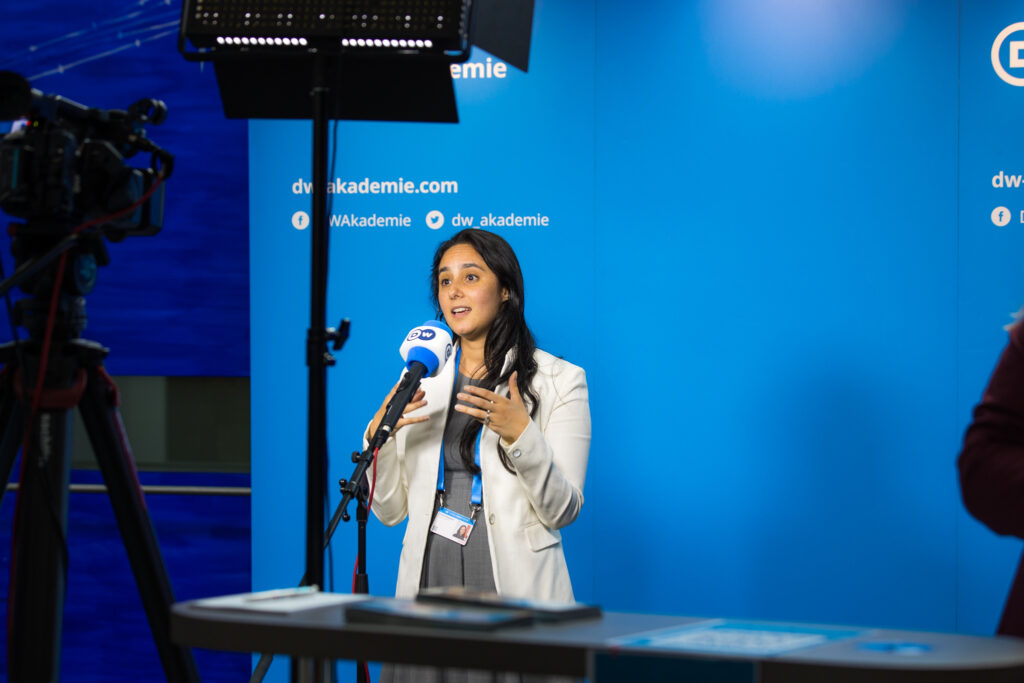
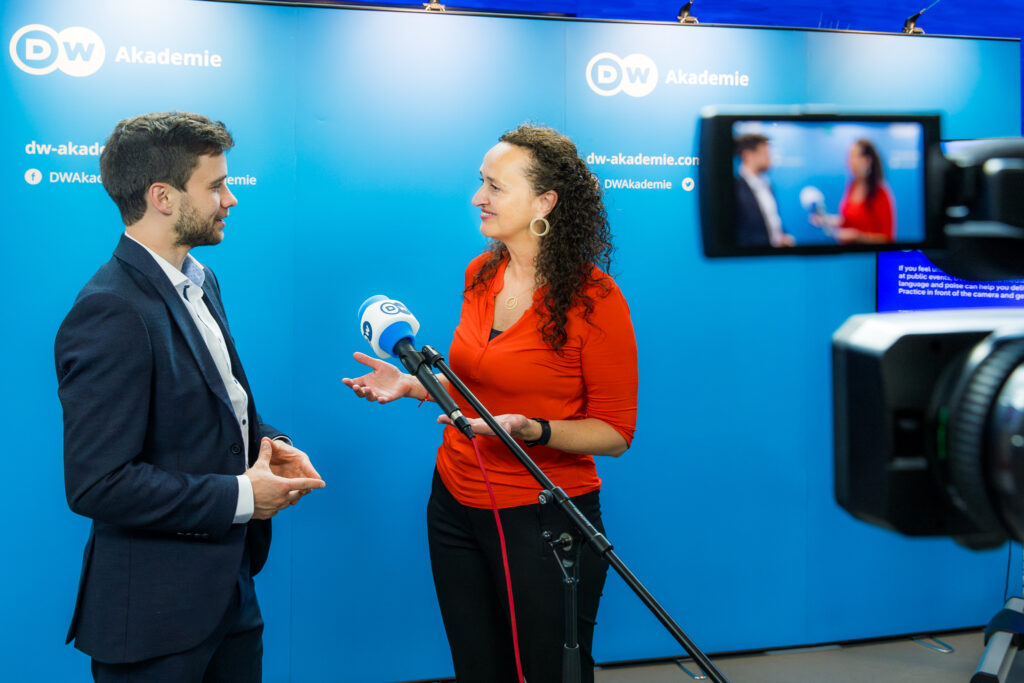
As part of the Humanitarian Forum, the Deutsche Welle Akademie will offer free Media trainings for all participants on the first day of the congress. (April 21)
If you feel uncomfortable giving interviews, making official statements or speaking at public events, DW Akademie media trainers can show you how gestures, body language and poise can help you deliver your message clearly and confidently. Practice in front of the camera and get feedback from the professionals.
You can register directly at the booth on April 21. The training sessions are offered in German and English.